French Riviera
58 cars available in Monaco, around 40 minutes from Nice Côte d'Azur.
City
Vehicle type
From
To
Handover
Start with the rule that catches everyone out. Under article 9 of the municipal order of 2007, access to Monaco-Ville — the Rocher — is closed to every vehicle except those registered in the Principality or in the Alpes-Maritimes. A car on an 06 plate drives up. The same model on a 75, 13 or 83 plate, or on foreign plates, does not, absent a derogation from the Mairie. Deliveries up there run 07:00 to 10:00 only. If your address is on the Rocher, the workable answer is the Parking des Pêcheurs, 430 spaces, with a free lift straight up into the old town — and we tell you that before you book, not when the driver is turned around at the ramp.
Article 2 of the same order sets the dimensions the whole Principality works to. Tourist coaches may not park or stand on the public road at all, only on reserved surfaces, and caravans are banned from circulating outright. Two square kilometres stacked against a hillside between Cap-d'Ail and Roquebrune leaves no room for exceptions, and Monaco does not enforce them casually.
| Limit | Value |
|---|---|
| Length | 18.75 m maximum |
| Width | 2.60 m maximum |
| Height | 4.30 m maximum |
| Over 7.5 t | Designated routes only |
| Over 3.5 t | Banned 08:00–09:00 |
Parking is run by the State, not by a private operator: the Direction des Parkings Publics manages 46 car parks and roughly 20,000 spaces, and the tariffs are fixed by ministerial order — the current one dates from 1 December 2025 and took effect on 1 January 2026. The first hour is free everywhere and the day is capped at €24. Les Salines, about 1,790 spaces at the western entrance with a free shuttle, runs its own reduced scale: free to 45 minutes, €7.50 for one to four hours, €11 for four to twelve. The number that matters to us is 2.20 m: above that height a vehicle changes tariff class outright. Most garages sit between 1.90 m and 2.20 m, with Salines, the Digue and the Grimaldi Forum going higher. We confirm the height before we confirm the car.
There is a legal asymmetry here that almost nobody writes down, and it shapes how we arrange things. Dropping you in Monaco and collecting you from Monaco are not the same act. A foreign private-hire company needs prior authorisation from the Direction de la Sûreté Publique and a vignette on the vehicle before it may pick up a passenger in the Principality, and the vignettes are capped — 105 annual, 210 for the high season, 28 for foreign taxis. Eligibility requires three years of existence and registration in the Alpes-Maritimes or the Var. Each journey has to be declared at least two hours before the client is collected. A French private-hire licence is not automatically recognised. So when the leg starts in Monaco, we route it to partners in our network who hold the vignette, and the two hours are our problem, not yours.
What is not a formality is the border. The customs convention of 18 May 1963 makes France and Monaco a single customs territory, so there is no frontier post and a French-registered car simply drives in. The regulated thing is the commercial carriage of passengers, not the movement of the vehicle.
The heliport sits in Fontvieille on the Avenue des Ligures, operated by the Direction de l'Aviation Civile, with eight pads — two of them out over the water — and approaches routed over the sea for noise. It has exactly one scheduled destination: Nice. The flight is seven minutes against thirty-five by road on a good day and past an hour in July and August, and the operators run something in the order of fifty rotations daily. It is the one place on this coast where the helicopter is not a flourish but the shorter, duller, more reliable option.
By road, the A8 feeds Monaco through exits 56 and 57 into the A500, which is largely underground, while exit 58 at Beausoleil reaches the northern side and lets you avoid the A500 tunnel when it backs up. Inside, the Principality is stacked vertically: the Rainier-III tunnel runs 1,560 m one way out towards France, the Albert-II tunnel 1,734 m mostly inbound, and the ground rises from sea level to 162 m across the whole territory — which is why there are 28 public lifts and seven escalator runs across 35 sites, and why a walk of 200 m on the map can mean three floors. The three corniches are the alternative to the motorway: the Basse Corniche is the D6098 along the water, the Moyenne the D6007 through Èze, the Grande the D2564 over La Turbie at up to 512 m.
Then there is the spring. The 2026 Grand Prix ran on Sunday 7 June, moved out of its traditional late-May slot, under a municipal order of 5 May. Between 4 and 7 June the Quai des États-Unis, Boulevard Albert Ier, Avenue de la Quarantaine, Rue Grimaldi, Boulevard Louis II and Avenue J.-F. Kennedy were closed outright, together with the Rocher Albert Ier, Rocher Noghès, Sainte-Dévote and Débarcadère tunnels; parking bans ran from 17:00 on 31 May to 8 June. The part that matters for planning is not the race weekend. Building the circuit takes six weeks, seven in a Historic Grand Prix year, and clearing it takes about three, with the roads beginning to reopen at 18:00 on race Sunday. Port-side addresses are compromised for a good part of spring, and the E-Prix in mid-May sits inside the same barrier season.
September repeats the pattern at the water. The Monaco Yacht Show occupies Port Hercule from 23 to 26 September 2026, and the show is the small part of it. In 2025, build-up began on 30 August, pedestrian restrictions ran from 30 August to 8 October, the Quai Louis II and the Jetée Lucciana were fully closed from 15 September to 1 October, and the Quai Antoine Ier closed between the Rascasse corner and number 14 from 8 September, open only to authorised vehicles and residents. A quayside handover in late September is agreed with the port, or it does not happen.
Two corrections worth having. The Rolex Monte-Carlo Masters is not played in Monaco — the Monte-Carlo Country Club stands in Roquebrune-Cap-Martin, on French soil, which makes a run there a domestic French journey with none of the above attached. And the speed limit across the Principality is 50 km/h, 30 in places, over a territory you can walk end to end. A supercar in Monaco is an arrival, not a drive. The driving is on the Grande Corniche, above La Turbie and towards the Col de Braus, and all of it is in France.
Delivery and handover
Villa, hotel, airport, heliport, berth — you give us the address, we work out what it takes to put a car there. In Cannes that is the entry height of the garage. On the Rocher in Monaco, it is the number plate. We check before we confirm.
Arrange delivery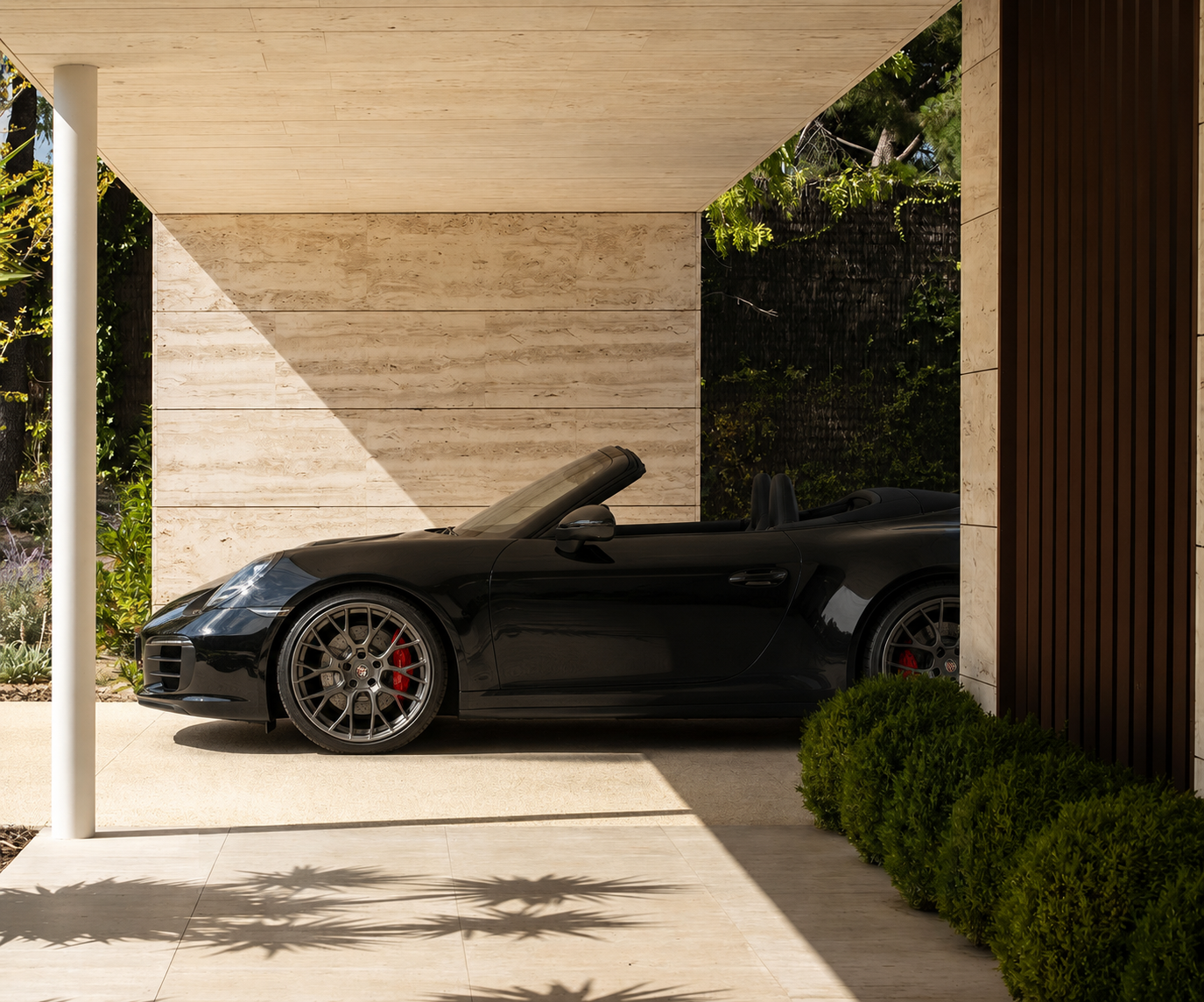
Make a request
Price and availability come from the person handling your file — not an autoresponder.
Reply within 5 minutes
Yes. Villa, hotel, berth, or Nice Côte d'Azur. Give us the exact location in your request — that is what lets us answer in minutes rather than hours.
Not all of them, and that is worth knowing before you choose. Access, ceiling heights and restricted zones rule some cars out street by street. Every vehicle page names the cities we deliver it to. If the one you want is not listed for Monaco, give us the dates anyway — the network moves.
They are set by the partner supplying the car, not by us: deposit, minimum age, licence seniority and mileage vary from one to the next. They are stated in the written proposal before anything is confirmed. We act as an intermediary; the deposit and the insurance are held by that partner.